

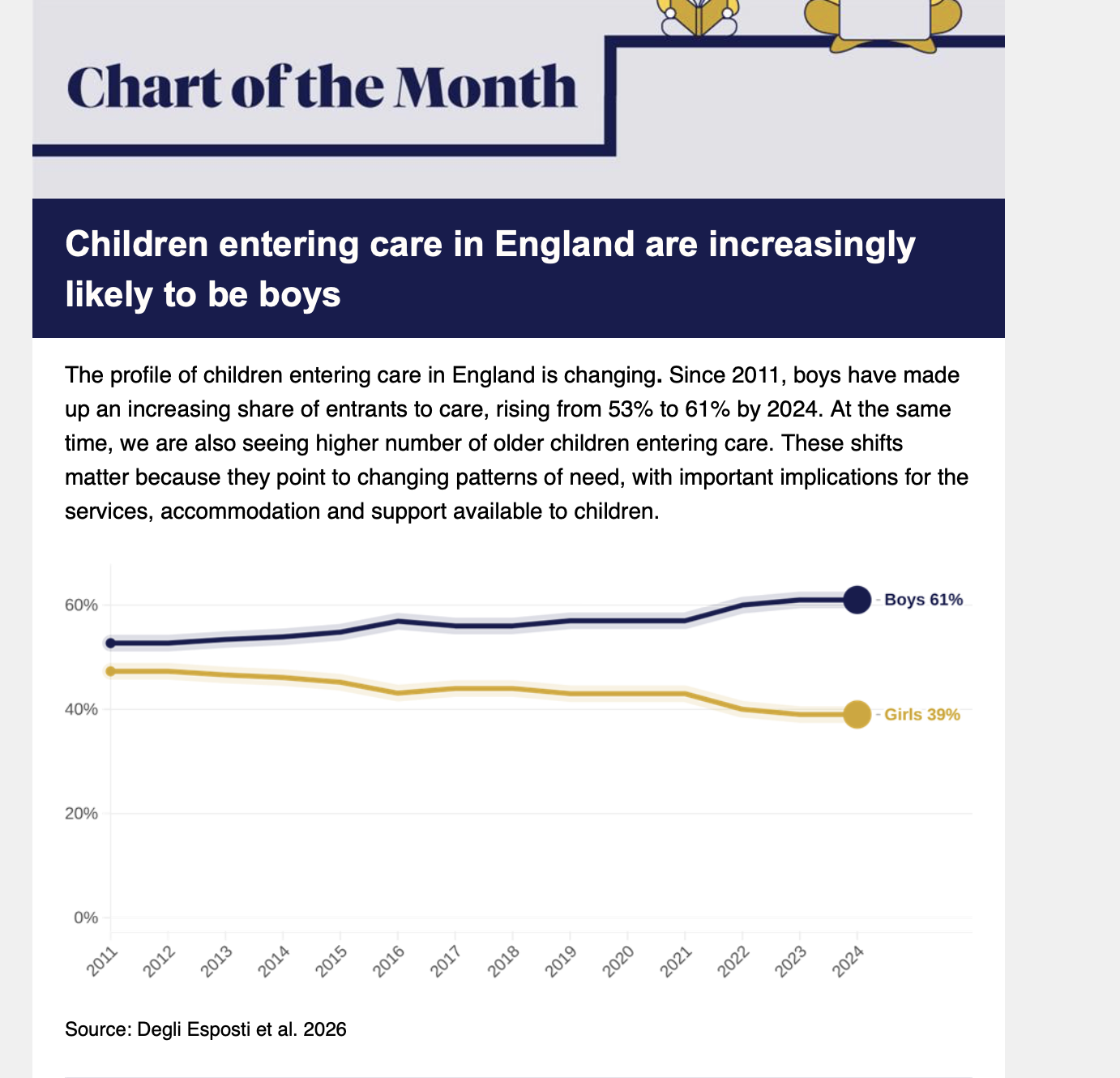
The Nuffield Family Observatory email a ‘Chart of The Month’, which I think is a nice, slow, passive way to consume data visualisations. This month’s chart shows that kids entering the care system are increasingly likely to be boys. It also point out that overall numbers are growing, kids are entering care older, and the system is not really optimised for any of those things.
This looks like it should be a poster in the backdrop of a scuzzy sci-fi dystopia. (from Canary Wharf).

I hope this quote from Professor Peter Fonagy in the trail to his independent review into mental health, ADHD and autism cuts through to people designing digital services (particularly the coaching, relational and behaviour change types)
“Saying to someone, ‘I notice you’re not quite the same as yesterday. Is there anything the matter?’ Knowing there is someone who knows makes an enormous difference.”
Machines are probably going to continue to get better and better at the noticing, but the second part is inherently about people.
Nationalise Parent Pay?
It is the time of year when the seam of parents grumbling about school apps rises to the surface of social media. Starting the school year (or starting a new school entirely, as my son has this year) is in part a todo list of digital admin. While not all apps equally bad, some border on unusable. Even the ones that are better designed represent a new set of user accounts to manage and a new help desk contact when things go wrong. ... moreOn waiting, digital and where the state chooses to operate - an extended version of the preface to Platformland
Below is a slightly longer version of what became the preface to my book Platformland. I started writing before the book even existed, when I just needed to start writing something, and ended up writing about standing in queues as a kid. I’ve always meant to publish it somewhere, and given the coming debate about the bounds of state ownership and public infrastructure now feels like a good time._ It’s a bit rough in places as I’ve had to glue it back together from various different drafts and the whimsy level is high in places. ... more
Published today with @kinship.works NHS Operating Patterns - Ways to do good work together, in a decentralised system
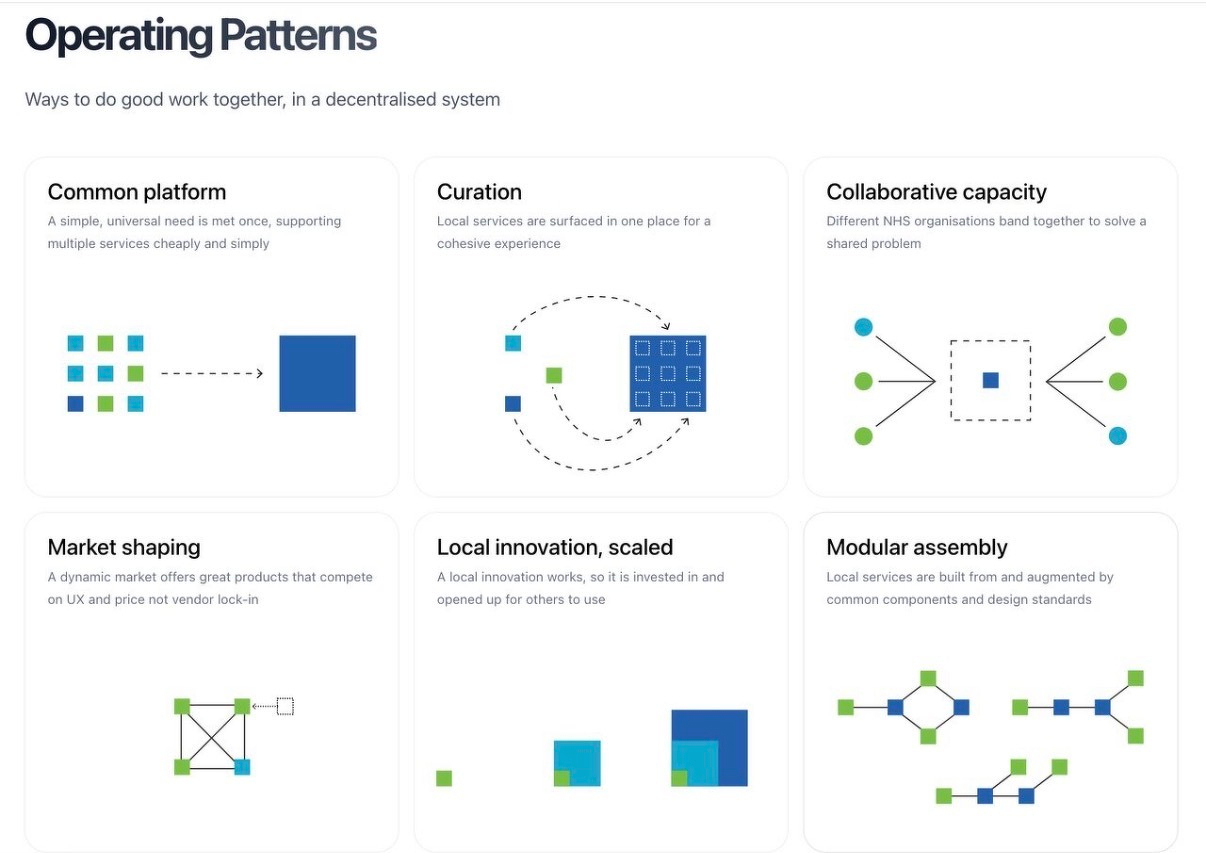

What have drawings of peas got to do with prototyping digital services? www.platformland.xyz/ways-of-d…
Why it’s important to thinking of public sector super apps from the viewpoint of ‘the system’, not just ‘the citizen’
I can’t tell isn’t was just a late 80s early 90s blip (or age induced nostalgia), but it seemed when I was younger questions of ‘confidence’ played out in the House of Commons, at least initially. Now they play out passively within internal party systems and are worse for it? All a bit ‘use your words’
Why doesn’t Starmer just call a confidence vote, or make Kings speech a confidence vote and have done with it? Or the challengers? The British constitution basically reduces down to who commands the House of Commons (with a few caveats). Short circuit all the ‘how many people have subtweeted?’ stuff
In 2018 (ish) at Harvard Kennedy School I saw a talk about cyber (my poor filing system means I can’t find the notes) that included the proposition: how you think about cyber depends if you believe vulnerabilities in software are common or sparse.
I wonder if the people panicking about Mythos + open source are experiencing a rapid transition between ‘sparse’ and ‘common’ viewpoints, while those in open source world were already in a mindset of ‘common and that’s why we do open source!’
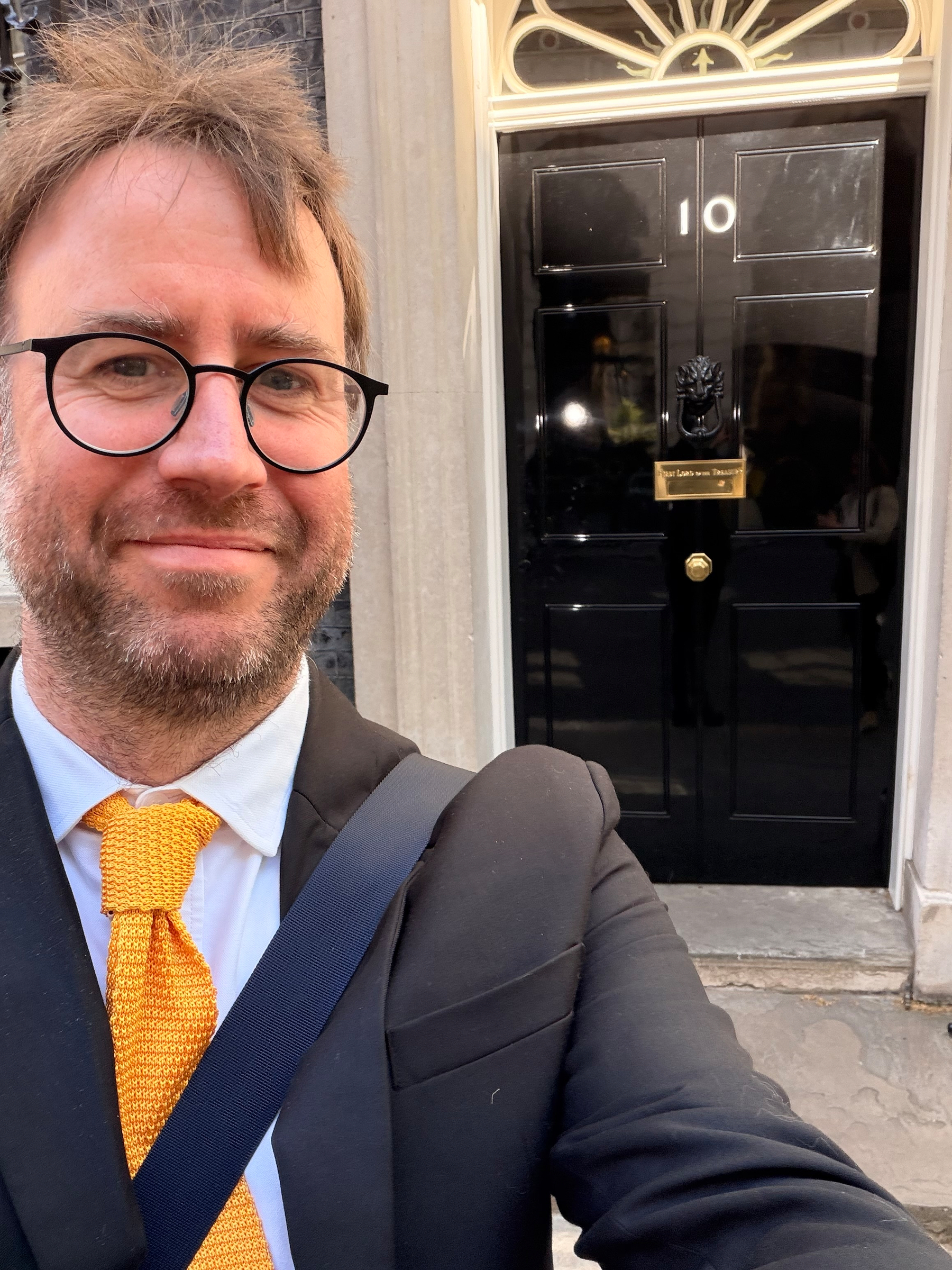 Popped in to see Larry
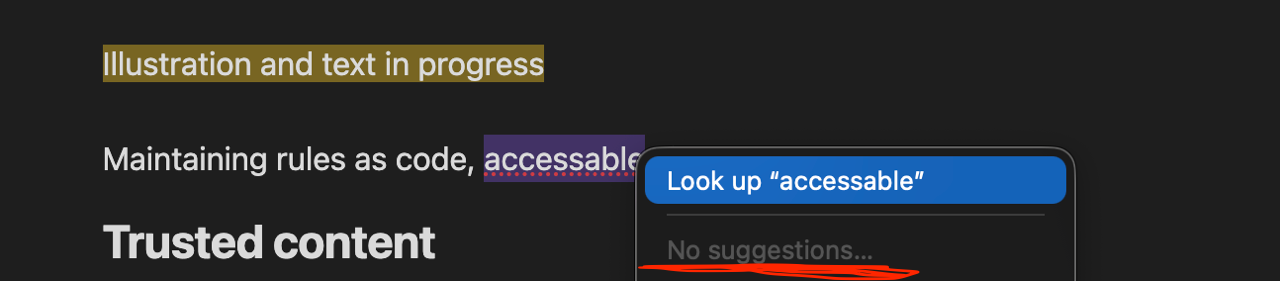
Given generative AI is all about predicting next words, when do I get a better spell check!? (I regularly have to Google words because my dyslexia induced misspellings are so bad my computer just shrugs).
Good thoughts from @edent.tel on closing open-source repos because Mythos:
https://shkspr.mobi/blog/2026/04/does-mythos-mean-you-need-to-shut-down-your-open-source-repos/
I would strongly recommend reading the UK’s AI Safety Institute’s evaluation of Claude Mythos Preview’s cyber capabilities and the NCSC’s advice. Neither of them recommend closing down Open Source code.
Keep coming back to this video in the context of AI-based public services: [www.youtube.com/watch
If mentalizing / epistemic trust is the key to learning some things, is it ever OK for machines to fake it, or should machines only be in a supporting role to human relationships.